The SA Karting Blueprint: Where to Start, What to Race, Where It Leads?
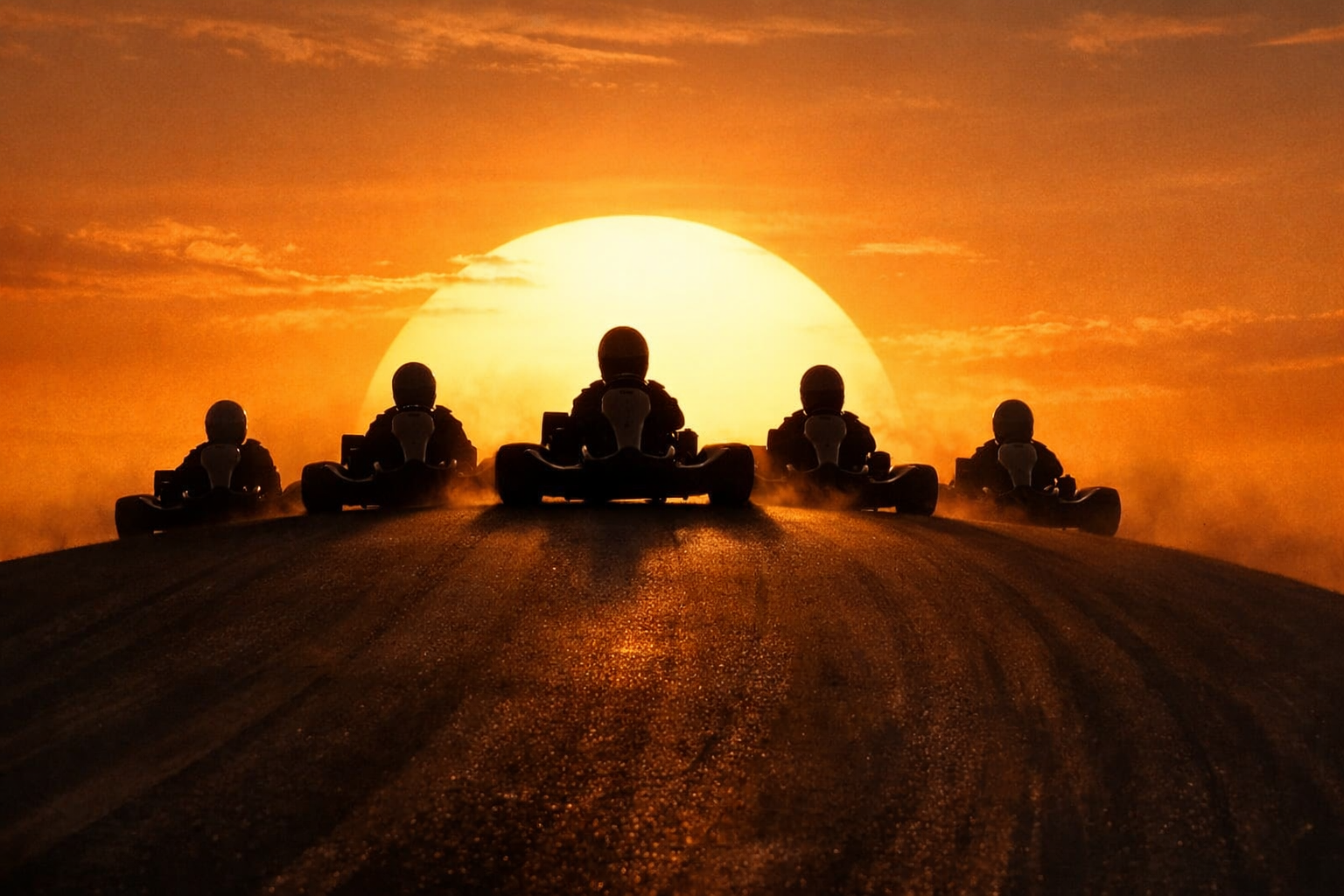
As the first light of dawn breaks over the circuit, the air is thick with the pungent smell of two-stroke oil, mingling with the eager anticipation of young racers readying for practice. This vivid beginning is where South African motorsport finds its heartbeat; it's the proving ground where past champions have cut their teeth and where future legends will sharpen their skills. From the spirited youth to seasoned pros, karting is the starting point for almost every notable South African racer. The energy at kart circuits every weekend speaks for itself. Karting not only hones driving skills but also builds sportsmanship, family ties, and a love of competition. We delve into the vibrant South African karting scene, covering the national championships that pave the road to international success and the grassroots clubs where many dreams take shape.
NATIONAL CHAMPIONSHIPS OVERVIEW
Karting championships in South Africa are more than just races; they are the breeding ground for the nation's future racing legends. Two main series dominate the national stage, each offering a unique path.
South African Rotax MAX Challenge (SARMC)
The Rotax MAX Challenge is South Africa's most competitive karting series, offering diverse opportunities across its seven distinct classes. Starting with the Bambino class for ages 5-9, the series is designed to serve a range of ages. The Micro MAX (ages 7-11) and Mini MAX (ages 9-13) classes offer early engagement for young racers. As they progress, drivers can compete in Junior MAX (ages 12-14) and transition to Senior MAX after turning 14. For more advanced skill levels, the DD2 gearbox karts are available for high schoolers aged 15 and older, while those over 32 can join the DD2 Masters category. This age-based class structure ensures that racers compete with peers of similar age and skill levels.
The series effectively combines both regional and national competition. Drivers earn points through select regional races held in Gauteng, the Western Cape, and KwaZulu-Natal (KZN). Their performance in four designated regional events directly contributes to their overall SARMC points, reinforcing the importance of regional racing as a stepping stone to national success.
Rotax South Africa has seen record participation in recent years, reflecting its popularity. National championship events are typically single-weekend race meetings, and there’s also a one-off Rotax African Open mid-season where local and African drivers compete. Critically, winning in Rotax opens global doors. Each year, South African Rotax champions qualify to represent the nation at the Rotax MAX Challenge Grand Finals, also known as the “Olympics of Karting,” with identical karts provided to all drivers. This Grand Finals opportunity is a huge draw where our best can race the world’s best on equal terms. South Africa has enjoyed much success at the event since its inception, having stood on the top step fourteen times. Rotax has also achieved FIA homologation for all its engines and classes, the only one-make brand worldwide with that status. Overall, Rotax offers large fields, well-organised events sanctioned by Motorsport South Africa (MSA), and a highly competitive yet family-friendly atmosphere.
ROK Cup South Africa
ROK Cup SA is another national championship, run on the Vortex ROK engine platform and increasingly integrated with FIA karting classes. The series features classes like Tillotson Cadet (ages 5–8), Mini ROK U/10 (ages 7–10), and Mini ROK (ages 8–13) for the youngest, then steps up to FIA-style categories: OK-J (ages 11–14) for juniors, OK-N for seniors (ages 14+), and KZ2 shifter karts (ages 15-30) at the top.
Why are seasoned drivers buzzing about 2026? The opening round of the 2026 ROK National Championship, taking place from 20–22 March 2026 at Red Star Raceway, will feature the FKR Shifter class competing as a collaboration with FK. The winner of the FKR Shifter class at this event will be awarded a ticket to the ROK Superfinal, adding extra prestige and incentive to this special appearance.
The ROK Cup structure is evolving, and in 2026, the championship will run over four weekends with double-headers (two rounds per weekend) to pack in eight nationals on a "one level playing field" schedule (a change designed to reduce travel while maximising race count).
ROK Cup SA emphasises driver development and a pathway to international karting success. The series uses pool engines and a parity-focused approach. Engines are centrally prepared, dyno-tested, and rotated to keep competition fair and de-emphasise spending wars on engines. This creates an even playing field where driver skill and setup shine. The payoff for champions is significant. While the top ROK drivers earn tickets to the ROK Cup Superfinal in Italy (the world championship event for ROK categories), the OK-N champion is slated to get a seat at the FIA OK-N World Cup, with the OK-J title holder earning themselves an entry to the FIA Karting Academy Trophy. Additionally, each national weekend winner in the Cadet and Mini classes will pocket R25 000. The prize money is subject to a minimum of 10 starters on the grid for each event.
OK-J weekend winners earn a test-drive in South Africa’s premier single-seater formula, MSA4, or a Ginetta Junior testing experience worth R25 000. The prize is also subject to a minimum of 10 starters on the grid for each event.
The OK-N National Champion will win a R100 000 tyre sponsorship for MSA4 sponsored by MSA4.
In short, ROK Cup SA provides a very direct bridge to the European/FIA ladder. The presence of OK-J and OK-N classes means ambitious drivers can train at home in the same equipment used internationally. The trade-off is that ROK grids in SA have been building up; while perhaps smaller than Rotax in some classes historically, the integration of FIA classes is attracting top young talent into a “flagship” senior direct-drive class that truly benchmarks them against world-level pace. Overall, ROK Cup SA offers a professional, internationally aligned racing program that is rapidly becoming a top national championship.
Tillotson T4 Series South Africa
The Tillotson T4 Series is the new kid on the block, offering an affordable four-stroke path into karting. Focused on cost control and simplicity, T4 uses a single-make Tillotson four-stroke engine on a spec chassis. It also runs multiple age classes. From T4 Mini (ages 8–12) up to Junior (ages 11–16) and Senior (ages 15+), all on a four-stroke platform. The selling point is accessibility: low running costs and low maintenance, yet a real racing experience. In fact, T4 is often praised as 'arrive and drive' friendly, perfect for newcomers or hobbyists who want close competition without the two-stroke costs. The series has been gaining momentum; it has produced success stories such as young Capetonian Radhi Harris, who in 2024 rose from the T4 Cadet ranks in SA to being crowned the T4 Bambino World Champion in Spain.
The T4 Nations Cup is Tillotson’s international finale, where the best four-stroke drivers worldwide compete in one massive event. South Africa sends a team to this event annually, showcasing our depth in grassroots karting.
Starting in 2026, Tillotson T4 South Africa will be officially sanctioned by MSA, cementing its status as a recognised club championship series in the sport’s hierarchy. This means “joining the blue revolution,” as the promoters like to say, and bringing the series further into the mainstream motorsport fold. T4 is also collaborating with other series; for example, Tillotson Bambino karts are used in ROK Cup’s Tillotson Cadet category to provide the youngest racers with a balanced, entry-level platform. As an entry point, the T4 Series is unmatched in affordability and still offers a route to the world stage (the T4 Nations Cup). The main limitation is that performance and speeds are lower than the Rotax/ROK two-strokes, and the fields, while growing, are smaller and more localised (Gauteng) at this stage. But for many drivers, T4 is where they get hooked. It’s fun, competitive, and budget-friendly. Once a driver masters T4, they can either pursue international four-stroke glory or transfer to a two-stroke class with solid racecraft already in hand.
REGIONAL CHAMPIONSHIPS OVERVIEW
While national titles grab headlines, South Africa’s regional karting championships are the regular battlegrounds that forge new talent. The Gauteng-based MSA Northern Regions championships are arguably the strongest, consistently drawing the largest grids and fiercest competition. For Rotax racing, circuits such as Zwartkops Kart Raceway in Pretoria and Formula-K Raceway in Benoni host packed monthly races, with double-digit fields across most classes. It’s not unusual to see 15–20 karts on a Junior Max grid or over 20 young drivers in Mini MAX at a Gauteng regional, sometimes including entrants from neighbouring provinces or countries. The MSA Northern Regions Rotax Kart Championship is run by the Rand Kart Club and ties into Rotax national scoring, keeping local racers on their toes for national points.
At the same time, the Vortex-powered MSA Northern Regions ROK Karting Championship races at similar venues, apart from Red Star Raceway, which serves as ROK Cup South Africa’s headquarters. Grids are again smaller than Rotax's, but they maintain the same philosophy of equal racing through their pool engine competition.
In the Western Cape, the regional scene centred on Killarney International Raceway in Cape Town is equally passionate, though a bit smaller in scale. Cape Town karters benefit from a strong local culture, and the iconic kart circuit hosts one national round of both the SARMC and ROK Cup each year. Western Province Motor Club (WPMC) Karting Championship races feature slightly leaner grids than Gauteng's, but are still of a high quality, with the region producing multiple national champions over the years. The Cape drivers relish their separate regional titles before joining their upcountry rivals at national rounds. The coastal conditions (sea level, occasional rain, and high winds) also provide drivers with a unique tuning and driving experience.
KZN is a smaller scene, yet it plays a key role. It’s home to the notorious iDube Raceway in Camperdown, a track with dramatic elevation changes and a reputation as one of the most challenging kart circuits around. KZN’s regional races, run by the KZN Kart Club, may have fewer entries, but have also produced numerous national champions. National races at iDube are often pivotal, truly “neutral ground” where neither Gauteng nor Cape drivers have the home advantage, and fitness and bravery are tested to the maximum. Many drivers only experience iDube during a national round, making the KZN regional experts invaluable. Beyond these main hubs, smaller clubs in Gqeberha (Algoa Kart Club) and East London (Border Karting) keep the sport alive in other provinces, contributing a few drivers to the larger championships each year.
All told, the regional scene in SA is vibrant. Nearly every weekend, there’s action in some part of the country. Gauteng, KZN, and the Western Cape run multi-round SARMC regional championships for Rotax classes, while ROK Cup focuses on regional events in Gauteng and the Western Cape. The regional races are family-friendly events where newcomers can learn the ropes and privateer racers can compete without the cost of long-distance travel. They’re the backbone of the sport, ensuring that when the national show rolls into town, a crop of homegrown racers is ready to defend local honour. The health of karting in SA starts at the club and regional levels, and right now it’s thriving across the country.
SO WHAT’S NEW FOR 2026?
Karting is always evolving, and the 2026 season brings a few noteworthy changes.
SARMC: No major class additions. The Rotax structure remains stable with Bambino, Micro, Mini, Junior, Senior, DD2, and DD2 Masters covering the full age spectrum. After aligning even more closely with international Rotax rules in 2025, the focus for 2026 is on continuity. Technical regulations see only minor updates for parity. So, drivers and teams can expect business as usual: a national and several regional championships under the Rotax banner, and the same reliable pathway from club to regional to national to Grand Finals. One subtle change introduced in 2025 that continues is the integration of regional results into national points, a revolutionary combined scoring system that remains for 2026. This ensures regional participation remains a key part of the Rotax journey.
ROK Cup SA: Big strides here. The class structure was recently revamped to mirror the FIA categories. 2026 will see the first full season with KZ2 back on the roster, reintroducing a true shifter kart tier for the first time since 2020. The senior direct-drive category is now OK-N (replacing the old Senior ROK), and juniors run the OK-J class, both using the modern OK engines aligned with global standards. For ages 7-10, the Mini ROK U/10 category provides a gentler introduction before they face the full Mini ROK field, which has always been the backbone of ROK Cup SA. Another structural innovation for 2026 is the national event format: ROK Cup SA is moving to four double-header national weekends, meaning each race weekend counts as two championship rounds. The change was introduced to align with international standards and increase intensity, requiring drivers to maintain consistency across back-to-back race days. ROK Cup SA’s alignment with FIA programs is also new and will fully materialise in 2026. In short, ROK’s ladder now clearly says: Tillotson Cadet → Mini → OK-J → OK-N → KZ2, with each step preparing drivers for the next, nationally and internationally.
Tillotson T4: The key update is official recognition and growth. MSA sanctioning from 2026 means the T4 Series will likely have a more formalised club championship and may attract more entrants, now that it’s under the national federation’s umbrella. The class structure remains: Mini, Junior, and Senior, with possible overlap for transition ages. T4 organisers are focusing on accessibility, so expect to see more “arrive-and-drive” packages and maybe an expansion into other regions (for example, more races at circuits beyond Gauteng’s Formula-K Raceway). For families, the main news is that T4 is here to stay and grow by lowering the barrier to entry. In 2026, we could see a boost in novice kart racers joining via the T4 route. And with strong results at the Nations Cup, South African T4 drivers have proven this series can produce champions, too.
Overall, 2026 is set to build on the 'karting boom' of the past few years. Rotax stays reliably strong, ROK is upping its game with FIA-aligned classes, prize money, and more racing, and T4 is opening the door even wider for newcomers. It's the perfect mix of stability and excitement. Imagine your driver taking that chequered flag next season, primed to join a grid that promises intense competition and the thrill of motorsport's future champions. Whatever your driver's age or ambition, there's a class and a series ready for them this season.
ROAD TO THE WORLD STAGE
One of the most exciting aspects of karting is that the road from your local circuit can lead to the world stage. South Africa’s top karting championships all offer links to international competition, making karting a truly global sport for a kid from South Africa. Here’s how local drivers can go abroad:
Rotax MAX Challenge Grand Finals (RMCGF): The Rotax series is famous for its annual RMCGF. Every year, national Rotax champions (and sometimes vice-champions) and African Open winners earn tickets to this global showdown. At the RMCGF, racers from more than 60 countries compete in identical karts supplied by chassis partners and sealed Rotax engines, eliminating any equipment advantages. It’s a pure driver talent contest. Team South Africa is usually large and successful, having won 14 titles since the competition’s inception in 2000. For South Africans, an RMCGF ticket is like gold and an opportunity to put your name on the world map.
ROK Cup Superfinal & FIA Events: ROK Cup SA champions also get the chance to race internationally. The big one is the ROK Cup Superfinal in Italy, essentially the world finals for ROK engine classes. Top drivers in Mini ROK, OK-J, and OK-N categories typically qualify to represent SA. Additionally, with ROK SA adopting OK-N and OK-J, SA drivers can aim to compete in FIA competitions. Notably, the national OK-J and OK-N champion qualifies to compete in the FIA Karting Academy Senior and Junior Trophy, a one-make series where each nation’s best drivers race under their country’s flag. Furthermore, to encourage the inclusion of women in motorsport, a place is now reserved for a female driver in each of the two categories, one of which was awarded to a South African in 2025. This selection, made by the FIA's Women in Motorsport Commission, guarantees female representation in this international competition. The FIA OK-N World Cup is another incredible opportunity for South Africans. It’s a direct pipeline from our local ROK Cup to the halls of FIA Karting. And let’s not forget KZ2: with that class back, our shifter drivers can aim for the KZ2 Super Cup or even the KZ World Championship in the future if they gain the right experience.
Tillotson T4 Nations Cup: The T4 series culminates internationally with the Tillotson T4 Nations Cup, held annually in Valencia, Spain, and is expected to expand into other European countries. Along with individual champions, this event is also about national glory, with drivers from each country competing across multiple classes for the T4 Nations Cup title. South Africa has enthusiastically sent teams since its inception and is amongst the top nations competing. In 2024, seven-year-old Radhi Harris clinched the Tillotson Cadet world title at the T4 Nations Cup, bringing home gold for SA. That highlights how even our youngest racers can shine globally. Typically, the top performers in the local T4 Series earn spots for the Nations Cup. It’s a more cost-conscious world, but the camaraderie and national pride are significant. As T4 SA grows, expect Team SA to expand and potentially compete against established European teams across more categories. The T4 Nations Cup is a testament that you don’t need a massive budget to compete internationally, just skill, determination, and a blue Tillotson kart!
Champions of the Future (COTF): One of the world’s premier international karting programs, run by RGMMC in partnership with FIA Karting, COTF hosts elite events across Europe in the same classes used at World and European Championships, namely Mini 60, OK-J, OK, OK-N, and KZ2. It’s open to global entrants, and South Africans have already made their mark. Drivers can enter directly via the COTF website, with the COTF Academy Series offering an affordable arrive-and-drive format that includes pooled engines and chassis to ensure fairness. Races take place at top European circuits like La Conca, Valencia, and Sarno, just ahead of FIA events, making it the perfect proving ground for young talent aiming to step up to formula cars.
In summary, each South African karting series offers a “golden ticket” to the international stage. Rotax gives you the RMCGF, ROK can propel you to the Superfinal and FIA events, Tillotson opens the door to a world four-stroke showdown, and COTF offers an elite proving ground for young drivers to compete on Europe’s biggest stages. Whether your goal is experience, exposure, or excellence, international opportunities are real and attainable. Competing abroad sharpens every aspect of a driver’s craft, from track adaptation to mental toughness. So, when a parent asks, “Where can this karting thing lead?”, the answer is: potentially, all the way to a world championship podium. And it all starts on our humble local circuits; that’s the beauty of it.
For more information on the various series contact:
ROK Cup SA: John Duvill – john@ftwmotorsport.co.za
SARMC: Jennifer Verhuel: jennifer@kart.co.za
T4 Tillotson: Marius Swanepoel: marius@formula-k.co.za
