Boshoff’s Polish Performance Underlines the Value of European Competition
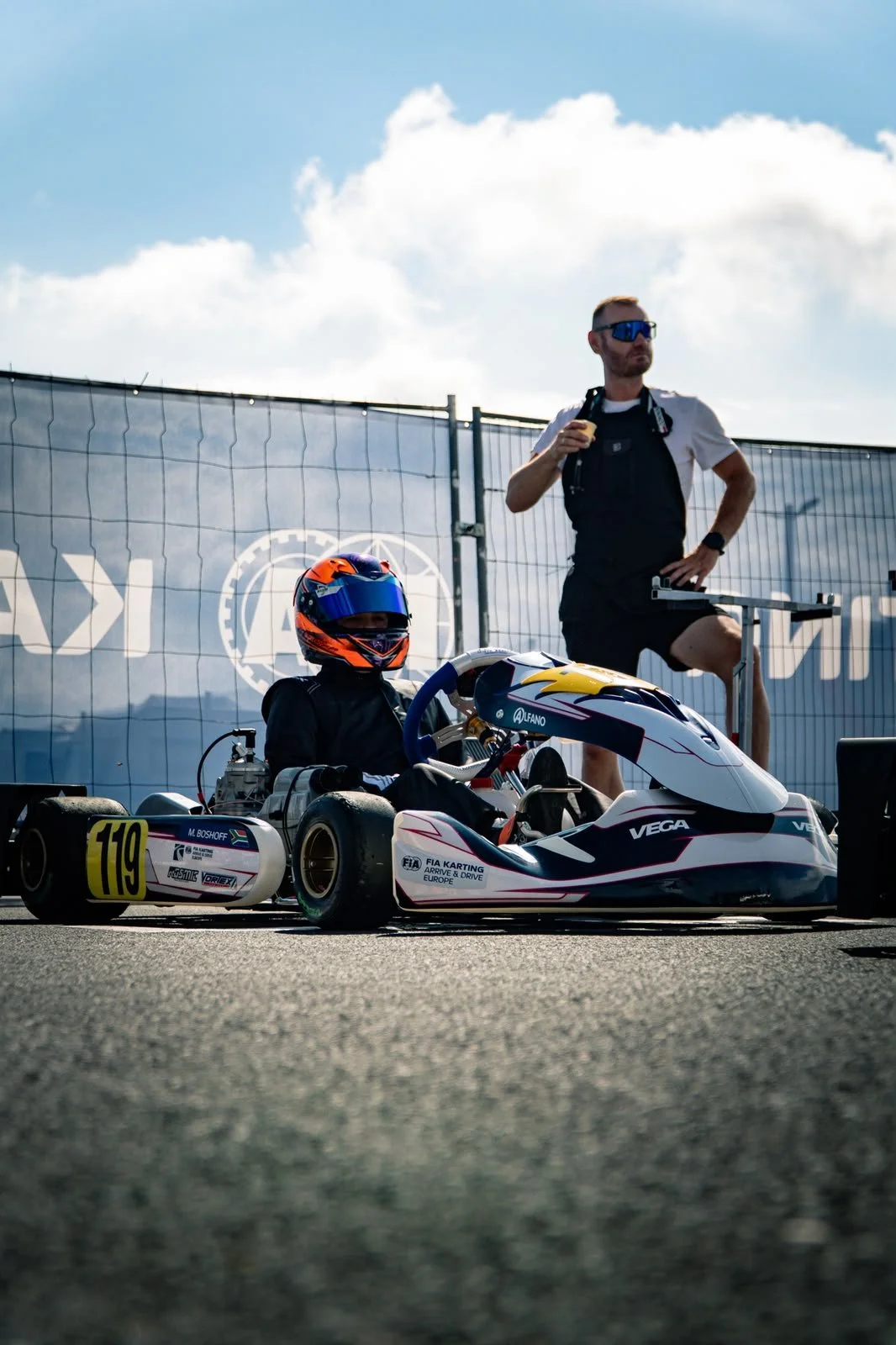
Max Boshoff’s latest international appearance delivered far more than the final result suggests, with the Capetonian showing competitive pace and strength during the FIA Arrive & Drive European Championship meeting at Autodrom Słomczyn in Poland.
Competing internationally remains an important part of Boshoff’s development. European racing places him against drivers accustomed to some of the most competitive karting environments in the world, while exposing him to unfamiliar circuits, different track surfaces and the intensity of closely matched international fields.
Each appearance offers an opportunity to benchmark his performance beyond the South African paddock and sharpen the racecraft required at the sport’s highest levels. Boshoff wasted little time demonstrating that he belonged in the company.
Starting from the fifth row of the grid for Sunday’s 17-lap Junior final, any hopes of converting that starting position into a front-running finish were dealt an immediate blow. Boshoff became caught in the opening-lap chaos and dropped from ninth to the back of the grid before the first lap had been completed.
It was the sort of setback that can quickly end a driver’s race, particularly in a tightly packed European field where overtaking opportunities are rarely offered freely. Boshoff, however, refused to allow the opening lap to dictate the remainder of his afternoon.
Once the race settled, he found his rhythm and began working his way forward. His recovery was patient rather than desperate, with Boshoff making steady progress as he moved through the midfield and reclaimed eight positions.
He eventually crossed the line in 12th place. A five-second penalty for a nose-cone infringement was added after the race, although it did not alter his final classification. The result itself was respectable considering the scale of the opening-lap setback, but the timing data provided a clearer indication of Boshoff’s true potential.
His quickest lap of 51.291 seconds came on lap 16 and was only 0.020 seconds slower than the fastest lap of the final. It was also seven thousandths quicker than the best lap recorded by race winner Maksymilian Piatek.
That pace was not an isolated flash. Boshoff progressively lowered his lap times during the second half of the race, producing a sequence of competitive laps once he found clear track. It confirmed that, without the first-lap delay, he possessed the speed to race much further up the order.
For Boshoff, the significance of the weekend extends beyond a 12th-place finish. International starts of this nature provide experience that cannot be replicated solely through domestic competition. They demand quick adaptation, precise qualifying execution, and the confidence to race wheel-to-wheel against unfamiliar opposition. They also provide an important measure of progress.
